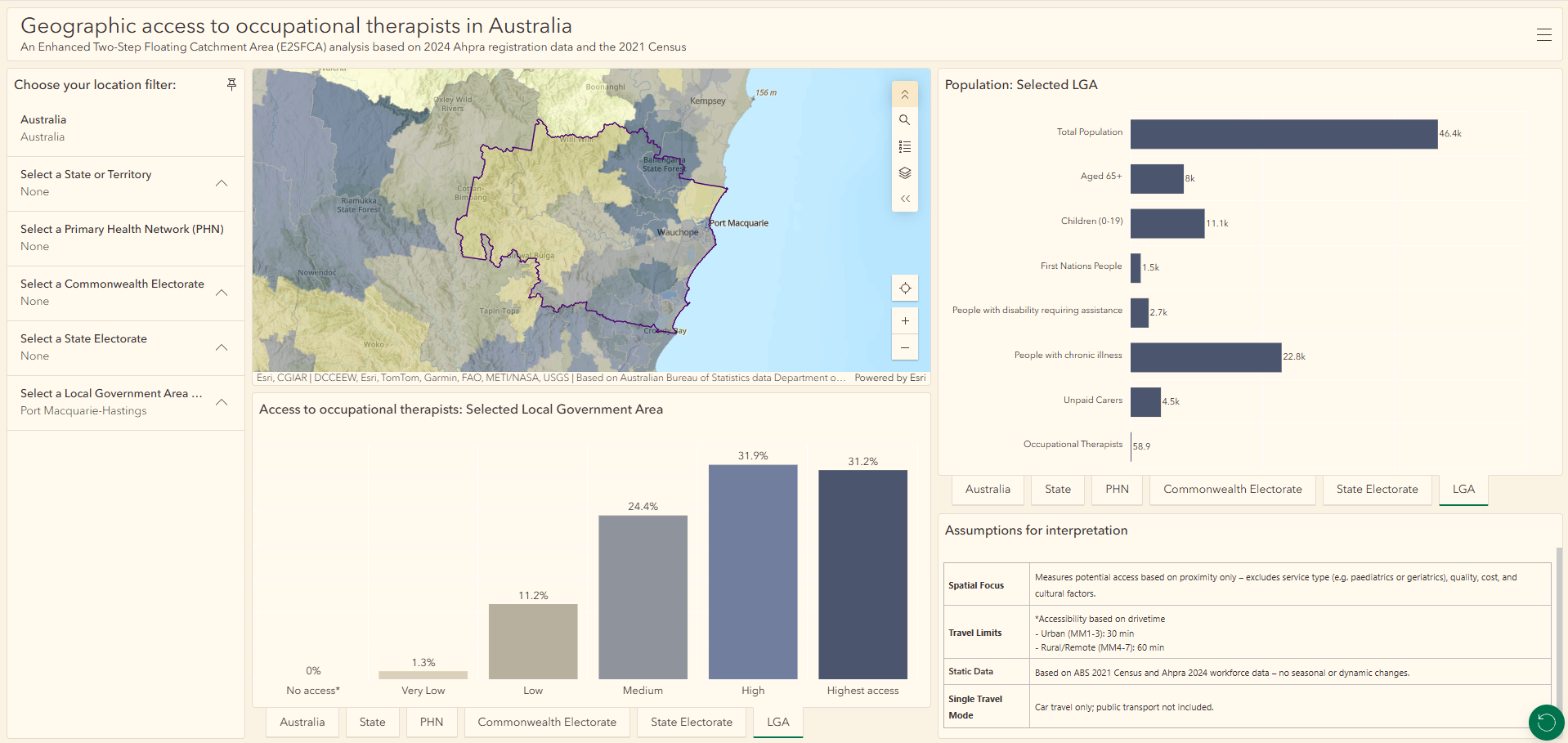
Access to health professionals is critical for equitable healthcare delivery and workforce planning, yet traditional methods of measuring accessibility often fall short. Current approaches typically rely artificial borders such as Modified Monash (MM) classifications or health service boundaries, which can misrepresent real-world access; clinicians located just across a boundary may be excluded, even if they are closer and more accessible to patients.
Advanced spatial accessibility models like the Two-Step Floating Catchment Area (2SFCA) method provide a more accurate picture by considering both provider supply and population demand without these boundaries. However, applying 2SFCA at a national scale has previously required supercomputing resources to process millions of population and provider points, leaving policymakers and industry without the granular insights they need.
A novel application of the 2SFCA method across the entire Australian continent, reported through a searchable online dashboard. Using innovative data handling and optimisation, we provide accurate, high-resolution accessibility indexes for census areas of 200-800 people.
The dashboard provides detailed maps and charts to reveal health service access disparities, supporting evidence-based workforce planning.