Every PhD has a story. For Josephine Ohenewa Bampoe, that story began in 2013 at Korle Bu Teaching Hospital in Ghana.
That year, Josephine began working at the hospital alongside Dr Karen Wylie, Nana Akua Owusu, and Clement Amponsah. As they worked with children and families requiring speech and language services, one major challenge quickly became clear: there were no culturally and linguistically appropriate assessment tools available for the population they served.
Many conversations about developing the speech-language pathology profession in Ghana returned to a central issue. Accurate diagnosis depends on accurate assessment, yet clinicians in Ghana were often relying on tools developed in countries with very different linguistic and cultural contexts. Dr Karen Wylie would often tell Josephine, “This could be a PhD topic for you someday.”
She was right.
When Josephine later decided to pursue a doctoral degree in speech pathology, she already knew what problem she wanted to address. Her PhD focused on developing a culturally responsive, evidence-based speech and language assessment tool for Ghanaian English-speaking children aged 5 to 10 years.
Ghana is one of the most linguistically diverse countries in Africa, with more than 81 languages spoken across the country. Many children grow up moving between one or more Ghanaian languages and English, depending on their home, school and community environments. In these multilingual contexts, language development is shaped by factors such as age of language acquisition, language exposure, educational experiences and social interaction.
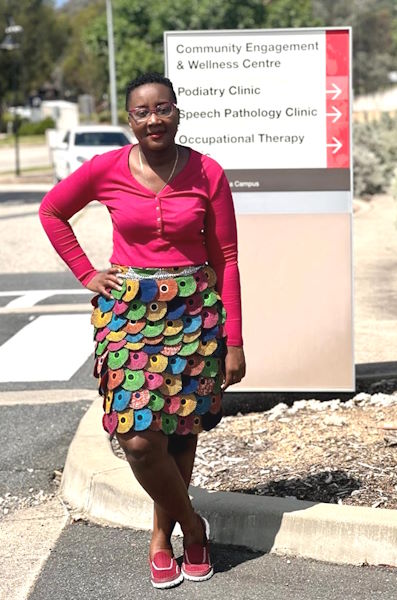
Josephine’s research sought to address this critical gap by creating an assessment tool grounded in Ghanaian linguistic and cultural realities. The absence of contextually relevant assessment tools posed significant challenges for clinicians and families. Assessment materials developed in Western countries often contain unfamiliar vocabulary, cultural references, communication expectations and developmental assumptions that do not align with Ghanaian children’s lived experiences. As a result, children risk being underdiagnosed, overdiagnosed or misunderstood.
Today, Josephine is proud to introduce the Bampoe Ghanaian English Speech and Language Assessment (B-GESLA), pronounced “Bee-JESLA.”
The B-GESLA is a formal diagnostic tool developed to support speech and language assessment for multilingual children in Ghana. Its development represents an important milestone for speech-language pathology in Ghana and contributes to broader efforts to improve equitable access to healthcare and education for children with communication difficulties.
This work is especially important because communication disorders can have lifelong consequences if left unidentified or unsupported. Children with speech and language difficulties may struggle academically, experience reduced classroom participation, face social isolation, or encounter long-term educational and employment disadvantages. In multilingual and low-resource settings, delayed or inaccurate diagnosis can widen existing inequalities in healthcare and education.
By generating locally grounded evidence from Ghana, Josephine’s research contributes to expanding global understanding of multilingual child language assessment. The project also supports broader discussions about equity and representation in healthcare and research.
Importantly, the project demonstrates the value of African-led research in addressing local healthcare and educational challenges. Rather than relying solely on imported models of assessment, Josephine’s work highlights the importance of developing evidence within the communities and contexts where services are delivered.
Acknowledgements: Josephine expresses heartfelt gratitude to her supervisors, Professor Sarah Verdon, Dr Karen Wylie and Dr Laura Hoffman, whose guidance and expertise supported the development of the project. She also acknowledges the contributions of her colleagues, Dr Karen Wylie, Nana Akua Owusu, and Clement Amponsah, whose early conversations helped shape the vision for the research.

1. Bampoe, J. O., Verdon, S., Wylie, K., & Hoffman, L. (2025). Application of a framework for culturally and linguistically responsive speech and language assessments in multilingual contexts: a majority world example from Ghana. Speech, Language and Hearing, 28(1). https://doi.org/10.1080/2050571X.2025.2553425
2. Bampoe, J. O., Verdon, S., Hoffman, L., & Wylie, K. (2025). Conceptualisation of a culturally responsive speech and language assessment for Ghanaian-English speaking children. International Journal of Speech-Language Pathology, 1-15. https://doi.org/10.1080/17549507.2025.2532790
3. Bampoe, J. O., Verdon, S. E., Hoffman, L., & Wylie, K. (2025). Speech-language pathologists’ perspectives on a prototype of the first Ghanaian-English speech and language assessment tool. International Journal of Speech-Language Pathology, 1-13. https://doi.org/10.1080/17549507.2025.2542459
4. Bampoe, J. O., Verdon, S., Hoffman, L., & Wylie, K. (2025). Piloting a speech and language assessment tool for Ghanaian English-speaking children: A qualitative content analysis of video stimulated recall. Folia Phoniatrica et Logopaedica. https://doi.org/10.1159/000547150
5. Bampoe, J. O., Verdon, S., Hoffman, L., & Wylie, K. (2026). Development of the first formal Ghanaian English-speech and language assessment tool for multilingual children: Application of a converging evidence approach. Folia Phoniatrica et Logopaedica. https://doi.org/10.1159/000550068
6. Bampoe, J. O. & Verdon, S. (2026, in press). Cultural and linguistic considerations when working with multilingual children. In McLeod & Goldstein (Eds.). Multilingual Aspects of Children’s Speech Sounds Disorders in Children (2nd edition). Multilingual Matters.
Charles Sturt University aligns our research, policies, procedures, and other work with the UN Sustainable Development Goals (SDGs). These are the most relevant SDGs for this initiative.